Friday, May 20, 2011
Birds Need You This Summer !!!
Wednesday, June 23, 2010
no2co2
The Background
It has been a while since the global scientific community reached the conclusion - Global Warming IS occurring and it IS influenced greatly by the release of greenhouse gases from human activities. But, at this moment, the international negotiations are stalemated and our national government and industries are taking only tentative steps to reverse decades of climatic depredation.
The no2co2 Philosophy: Individual responsibility
no2co2 believes that the climatic catastrophe staring us in the face is but a symptom of our fractured relationship with nature. And while the threat of a catastrophe is looming, it is also an opportunity to “Evolve” to a new, more sustainable, paradigm of living and doing business. While top-down interventions from the governments, industries and policy are essential, the primary responsibility rests with us – as part of the societies we live in, as part of the businesses we conduct, and, as individual consumers.
The no2co2 Approach: Realise Minimise Neutralise
Step 1 – Measure and Analyse - REALISE
Animals living in close proximity of Nature often have an instinctive understanding of how their activities are impacting their immediate surroundings, and therefore, the wisdom to course correct. However, over the past few centuries, as we have become increasingly specialized in the functions we perform in our societies, we have largely lost not only this understanding of our surroundings, but also a general understanding of what it takes for us to lead the lifestyles that we do. We usually think of electricity as something that comes out of the socket in the wal,l and seldom as a resource that comes from coal that is burnt on a faraway factory. Sometimes the backward linkages are relatively easy to trace. Most often they are not. A veil of uncertainty often shrouds the environmental impact of our activities. The effects are too distant, nebulous and the measurement process and the benchmarks are not clearly defined. Over the last few years, no2co2 has built up expertise in breaking up and analysing the processes and systems around us – the things we use, the food we eat, how we travel, where we stay, how we socialize. The effort is to evaluate each aspect of our lives in terms of the footprint that it leaves on the environment. We aim to arm each individual with an objective unit to clearly evaluate the environment impact of any decision that he/ she takes – the Carbon Footprint. We believe that if used widely enough, and for long enough, it will enter into our collective conscience to the extent where it will actually start having a demonstrable effect.Step
2: Adapt and Adopt – MINIMISE
The Minimisation journey is not an act of penance, but “Evolution” to a new way of thinking, living and doing business, that will reverse the effects of years of imbalance between our consumption and Nature’s ability to sustain. It involves behavioural changes in our current consumption patterns – adapting to a more sustainable way of living and working, and adopting technologies and processes that reduce the environmental impact of our existenceStep
3: Offset through participation in projects that are logical, verifiable and socially relevant - NEUTRALISE
Offsetting is not the easy route to atone for our ‘climatic sins”; but it can be an opportunity to get involved in projects that are instrumental in not just offsetting one’s own footprint, but also in stimulating behavioural change on a wider social scale.
The no2co2 interventions: What we do
no2co2 seeks to intervene at each of the three stages of one’s behavioural change journey summarized elegantly in the three steps of REALISE, MINIMISE and NEUTRALISE
1. To inform/ measure
A measuring tool does not merely produce a “Result ” in terms of a “number”; it serves as a tool to educate, prioritise and to and record the process of behavioural change. The Basic Calculator featured on the no2co2 website and the various customized versions that we are constantly in the process of developing and fine tuning, serve as the lynchpin around which information is organized and disseminated. The Calculator can be customised in various ways – by the process that is being studied, by the target audience or by the presentation layer. The possible intervention points are roadshows, one-off or a series of workshops at events, organizations, educational institutions, in partnership with citizens’ organizations, individuals and groups that have experience of environmental education.
2. To consult/ facilitate
no2co2 is constantly looking for, reviewing and evaluating new technologies, processes and partnerships that have a lower environmental impact. In some cases, it means dipping into our traditional knowledge base, while in other cases it involves identifying new technologies and processes.We aim to build up a comprehensive, peer-reviewed “Resources” database, and also provide more hands-on consulting in implementation and monitoring of these solutions in case of specific projects.
3. Portfolio management
no2co2 is striving towards a more participatory and socially relevant approach towards offsetting, while maintaining the checks and balances that have been put in place through methodologies that are already prevalent This approach will be finalized and offsetting projects will be identified in the next few months.
How much you pollute the planet calculate it by yourself by this link
http://www.no2co2.in/CarbonCalculator.php
Sok 777
Tuesday, June 15, 2010
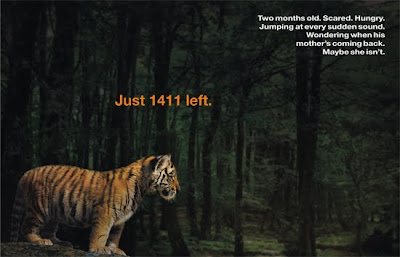
Just 1411 left.

Our national animal is fighting for its life.
From around 40,000 at the turn of the last century, there are just 1411 tigers left in India.
If we don’t act now, we could lose this part of our heritage forever.
Speak up, blog, share the concern, stay informed… Every little bit helps.
Aircel has partnered with WWF-India to help save our tigers. Explore the site to know how you can help.
Watch this space for updates from Stripey, the tiger cub.
www.Plant-Trees.org - Trees for the Future
Our mission and history demonstrate how dedicated we are to sustainable agroforestry. Learn more about us by clicking on the links below:
The earth is warming up, and the best available evidence points to the increasing concentration of greenhouse gases as the leading cause.
Deforestation and climate change are intimately connected: Globally, deforestation releases nearly 2 billion tons of carbon dioxide per year, and is responsible for nearly 25 percent of man-made CO2 emissions. The destruction of the world's forests not only harms the communities that depend on them, but increasingly affects us all.
While the root causes of deforestation vary from region to region, there are some common solutions. Communities need seeds, training, and technical support in order to adapt long-standing cultural and agricultural traditions (such as gathering fuelwood in nearby forests and practicing slash-and-burn agriculture) to new realities. Starting nurseries and planting trees is part of this process.
It is not too late. We are solution-oriented people. We have developed programs that work, which are restoring trees and forests to degraded lands. We are working with individuals, communities, and other organizations around the world with a shared vision for a positive change. We are a hands-on people-to-people program at the grassroots level, and we are leading by example.
Agroforestry is a land-use system that integrates agriculture, trees, people, and animals in the same space, resulting in improved soil quality, higher yields, and improved standards of living. Agroforestry has been practiced around the world in varying forms for thousands of years, and as such it works well with the low-input land-management systems that are common throughout the developing world. Our role is to train communities in advances in agroforestry, and to facilitate the diffusion and promotion of these strategies.
Agroforestry techniques are tailored to the needs of the community. In communal forests, tree planting programs focus on large-scale reforestation and the promotion of non-timber forest products. In agricultural fields, fast-growing multipurpose tree species are integrated into the agricultural system for specific functions such as a windbreak, firebreak, woodlot, living fence, contour-planting for erosion control, and alley-cropping to improve soil fertility.
To learn more about agroforestry, you can download a copy of our agroforestry training manual, or join our free distance training program.
1) | Stop putting more carbon dioxide into the air, and |
2) | If you do put CO2 into the air, absorb it and store it. |
1) | To encourage people around the world to use fossil fuels more efficiently,
and even more important, to switch to renewable energy sources. |
2) | To protect old-growth trees and rainforests as “warehouses for carbon”
and to harvest existing forests in a sustainable manner. |
3) | To plant trees in the tropics to offset the carbon dioxide that we produce. |
In simple terms, reduce what you can, and absorb the rest by planting trees in tropical locations.
Trees for the Future plants trees at less than 10 cents per tree. These trees absorb about 50 pounds of carbon dioxide per year. Planting trees is a great way to help mitigate some of your impact on the planet. Please donate today, and help us plant trees!
Donate and Help Us Plant Trees
Click here to make an online donation, or click here to find out more about donating stocks, cars, in-kind donations, and sending in a donation through the mail. Our average cost per tree planted is under ten cents, and we also offer tree planting certificates that make a great gift.
Learn More About Agroforestry
You can learn more about agroforestry by clicking here to download a free copy of our agroforestry training manual or clicking here to review our online agroforestry resources.
Help Start a Project
If you are interested in starting a new project, or know someone who is, please click here to fill out our project application form
Volunteer
Volunteers are always needed. We are primarily interested in people with language skills that can help us translate manuals and training materials into different languages. Please click here to fill out our volunteer application form.
Join us on Facebook
We have an active facebook presence, click here to visit our profile page.
Ask a Question
If you have any ideas, suggestions, comments, or concerns, please email them to info@treesftf.org
Country Programs | ||||||||||||||||
These are our current programs where our field representatives are organizing regional tree-planting efforts. Click on the country for the latest information. | ||||||||||||||||
In conjunction with these major projects, we are working in thousands of communities across the globe through our distance agroforestry training and seed distribution program. Click here for more information on our distance training program. To fill out a project application to receive seeds and training materials, please follow these links (English) (EspaƱol).
| ||||||||||||||||
| GPS Monitoring:Click here to see the locations of nurseries, planting sites, and villages in Google Earth (last update for points: March 2010)
| ||||||||||||||||
| ||||||||||||||||
Trees for the Future P.O. Box 7027 Silver Spring, MD 20907 1.800.643.0001 or 1.301.565.0630 Skype: treesftf | |